

Dear participant, we are delighted to welcome you to our Lied Competition in the European city of Görlitz-Zgorzelec. Görlitz-Zgorzelec is a special city: on the one hand, it is binational (one half belongs to Germany, the other to Poland), and on the other hand, it is one of the most architecturally rich cities in Germany. Almost the entire city has preserved its original structure and showcases treasures from all periods of European history, including the Renaissance, Baroque, Classical, and Gründerzeit (the industrial heyday of the late 19th century). It was precisely around this time, the turn of the century, that our city experienced a particularly vibrant cultural scene. Singing societies (Gesangsvereine) sprang up throughout the region, meeting annually for festivals to sing together. The Silesian Music Festival is perhaps the oldest festival in Europe (founded in 1830). The diplomat and composer Bolko von Hochberg, born in the famous Fürstenstein Castle (now Książ Castle in Poland), returned to his Silesian homeland after his directorship at the Royal Theater in Berlin and dedicated himself to the Silesian Music Festivals, which were first held in Jelenia Góra in 1876 under his direction. He developed this festival into one of the most important in Europe. In 1910, he opened the Görlitz City Hall (Stadthalle) for this purpose, one of the most beautiful concert halls with outstanding acoustics for singing. But in 1914, the First World War broke out. A dark time began in Europe, and a second, terrible world war changed the face of the region forever. While Görlitz belonged to Prussia before the war and had a significant Jewish community, it is now divided between Poland and Germany. Sadly, the Jewish community no longer exists. Only the magnificent monuments, the synagogue, the department store (Kaufhaus), and the city hall serve as reminders of that wonderful time.
I want to build on this era and remind us, the younger generation of Europe and the world, of this golden age, so that we can draw inspiration from it for a better future and use our art to dispel the spectre of war. Today, we are in the heart of Europe, at the bridge between East and West. Here, I would like to invite you, the ambassadors of culture, to celebrate not only the European, but also the rich musical heritage of the entire world through our singing.
The third edition of the competition is co-financed by the European Union. The INTERREG Poland-Saxony Fund supports joint projects between Poland and Saxony, enabling us to discover our shared cultural heritage and get to know each other better through cultural tourism. We warmly welcome culture enthusiasts and musicians from Poland, Germany, and all over Europe.
Bolko von Hochberg The story behind the competition
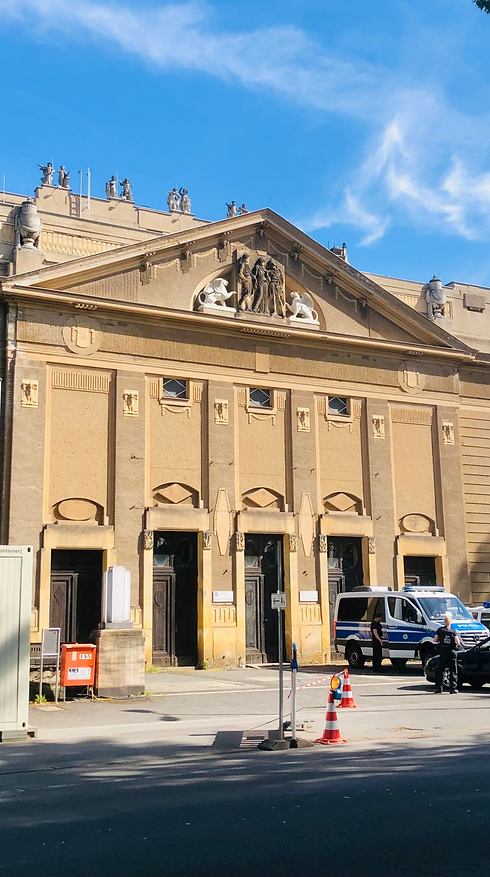
I launched this European festival in 2021 (postponed to 2022 due to the pandemic) with the vision of establishing it as a cultural festival connecting Poland, Germany, and Europe. The vision was, and still is, to hold this "festival" in the future in the renovated Stadthalle. Not least, Orpheus and Eurydice are depicted on the pediment of this concert hall.
The first edition of the competition in 2022 was entirely dedicated to the theme of "Hellas," inspired by ancient Greek culture. Görlitz-Zgorzelec is rich in neoclassical architecture and has been home to a Greek community for 100 years, to which my family also belongs. The candidates' repertoire included songs by Schubert, Brahms, Ravel, Jean Coultard, and Nowowejski. In 2024, the second edition took place in the Stadthalle, under the motto "Orpheus: Spirit of the Renaissance." The participants sang songs set to poems by great poets of the European Renaissance and Baroque periods, including Shakespeare, Petrarch, Corneille, and Metastasio.
Now we embark on another journey through the world's musical heritage, exploring the song for God and the songs of the peoples of the earth. Alongside American spirituals and folk songs by Brahms, Britten, Ravel, and many other great composers, our repertoire also includes a new composition: the "Three Silesian Sacred Songs" by the Dutch composer Hans Leenders, written especially for this competition.
We are planning two further editions: one in the Schubert Year of 2028 and another to coincide with the reopening of the Görlitzer Stadthalle in 2030. The concert hall will undergo extensive renovations until that year, and we hope that our Europe will then shine with the same renewed and festive splendor.
We wish all participants in the competition much joy in their preparations. The competition offers talented musicians a platform to showcase their passion for the Art Song and to meet like-minded artists and the jury in our beautiful city. We are convinced that it will be an unforgettable experience for all of us and will shape our future artistic careers. Let us be inspired by singing and by Görlitz.
Eleni Müller
Görlitz, January 2026
First Lied Competition "Bolko von Hochberg" 2022

HELLAS
The repertoire for the first edition of the competition in 2022 was dedicated to works inspired by classical Greek culture. This included songs by Franz Schubert, Brahms, Walf, Gounod, Debussy, Nowowiejski, Maurice Ravel, Hermann Reutter, and Jean Coultard. The complete repertoire can be found here.

LOCATIONS | SPONSORS
The first round took place in the Upper Lusatian Hall of Fame, which today houses the Cultural Center (Dom Kultury) in Zgorzelec, Poland. The semi-finals and final were held in the magnificent Gerhart Hauptmann Theatre in Görlitz. Sponsors included the municipality of Ottobrunn near Munich, the city of Görlitz, the Upper Lusatia-Lower Silesia Foundation and Savings Bank, the Görlitz department store, the Bechstein piano factory, and the Hotel Via Regia in Görlitz.

JURY
The first edition of the competition brought together leading figures in the music world from Saxony, Poland and Greece: Prof. Britta Schwarz, Prof. Alexander Schmalcz, Alexandros Charkiolakis, Prof. Ewa Biegas, Bartosz Żurakowski, Ulrich Kern and the initiator Eleni Ioannidou.

PRIZEWINNERS 2022
The prizes went to Vassia Alati (soprano) & Yuto Kiguchi ( Greece-Netherlands, Japan) First Prize, Benjamin Sattlecker (baritone) & Alexandra Helldorff ( Austria, Austria-Russia) Second Prize, Remy Burnens (tenor) & Clémence Hirt ( Switzerland) Third Prize, Prize for best pianist: Yuto Kiguchi. Special prizes: Annie Fassea & Dimitra Kokkinopoulou, Vincent Kusters & Charlie Bo Meijering, Jan Bukowski & Eukyeong Kim, and Kamila Goik & Malgorzata Wilga.
Second Lied Competition "Bolko von Hochberg" 2024

ORPHEUS, SPIRIT OF RENAISSANCE
The repertoire for the second edition of the competition in 2024 was inspired by the Renaissance. The singer Orpheus, who with his lyre and song could even touch the ruler of the underworld, embodied the idea of the rebirth of art song in Renaissance Italy. Poets such as Petrarch, Lope di Vega, Shakespeare, Corneille, and Metastasio inspired composers such as Liszt, Schubert, Rossini, Beethoven, Wolf, and Strauss.

JURY
The second edition of the competition brought together leading figures in the music world from Saxony, Poland and Greece: Prof. Britta Schwarz, Prof. Alexander Schmalcz, Alexandros Charkiolakis, Prof. Ewa Biegas, Bartosz Żurakowski, Victor Medem and the initiator Eleni Ioannidou.

LOCATIONS | SPONSORS
The first round took place in the Upper Lusatian Hall of Fame, which today houses the Cultural Center (Dom Kultury) in Zgorzelec, Poland. The semi-finals and finals were held in the Görlitz City Hall, which was in need of renovation. Sponsors included the Cultural Foundation of the Free State of Saxony, the Sparkasse Oberlausitz-Niederschlesien (Upper Lusatia-Lower Silesia Savings Bank), the Görlitz department store, the Saxon State Ministry of the Interior, the Hotel Via Regia, and Bechstein. The project also won the competition for associations in Eastern Upper Lusatia.

PRIZEWINNERS 2024
The prizes went to: Sarah Gilford (soprano, UK) and Ewa Danilewska (Poland) – First Prize. Jessica Harper (soprano, Australia) and Anna Alvizou (Greece) – Second Prize. Theano Papadaki (soprano, Greece) and Thomas Eeckhout (Netherlands) – Third Prize. The special prize for best pianist went to Daniel Silcock (Scotland). Special prizes: Audience Prize to Jan-Henrik Witkowski and Doriana Tchakarova (Germany), Jaewon Jung and Eunshil Oh (Korea), and Jana Margová (Slovakia) and Grzegorz Biegas (Poland).